
An international framework for tackling NCDs has been established, with nine voluntary targets on NCDs, agreed by WHO member states. The Sustainable Development Goals also include a target on NCDs.
SDG Target 3.4:
By 2030, reduce by one third premature mortality from non-communicable diseases through prevention and treatment and promote mental health and well being
However, only a handful of countries are on track to achieve this target, and many low- and middle-income countries lag far behind, not least because of the competing priorities of infectious diseases and maternal and child health, toward which health systems and donors have been orientated to respond. Country-level implementation requires political will, innovative funding and improved coordination across the health system, and more widely across national government.
In-country progress has been insufficient and highly uneven, and it is the vulnerable and marginalised who are left behind. There is a severe mismatch between the scale of the NCD challenge and the allocation of official development assistance: only 2% of development assistance for health is spent on NCDs. Now, following COVID-19 and amid worldwide fiscal pressures, the aid pot has shrunk further, just as health systems have been put under increased strain.
The UK Working Group on NCDs calls for NCDs to be a priority for UK international development.
Ahead of the next UN High-level Meeting on NCDs (HLM4), to be held in September 2025, the UK Working Group has been meeting regularly with the UK government (FCDO and DHSC) to keep them informed of the views of UKWG members on the drafts of the Political Declaration that will be approved at HLM4. The Declaration went through several rounds of negotiation and the UKWG – following the lead of the NCD Alliance – wrote on 28 July to the UK’s Mission at the UN in New York to express concerns about weakening of some crucial language in the ‘Rev 2’ draft: more information about the shortfall in the draft and our letter can be found here.
Following the election of a new UK government in 2024, the UK Working Group developed a briefing paper setting out why NCDs should be a priority for international development. It calls on the government to: a) prioritise preparation for the High-level Meeting, b) allocate specific funding as part of the UK’s global health objectives to ensure greater NCD investment and c) ensure that civil society and people with lived experience are meaningfully engaged in health programming in low- and middle-income countries. Read a blog about this briefing here or download it below.
In January 2022, the UK Working Group on NCDs cohosted (with Action for Global Health) a webinar with colleagues from the Foreign, Commonwealth and Development Office and the Department of Health and Social Care, launching a new report on Non-communicable Diseases and UK Aid in the Era of COVID-19. A set of policy recommendations drawn up by the Working Group was also presented at this meeting, which will direct our advocacy into the future. This was the culmination of a six-month project to consider the place of NCDs in UK aid through the lens of people living with NCDs: the authors of the report and the lead speakers in the launch meeting are all people with lived experience of NCDs.
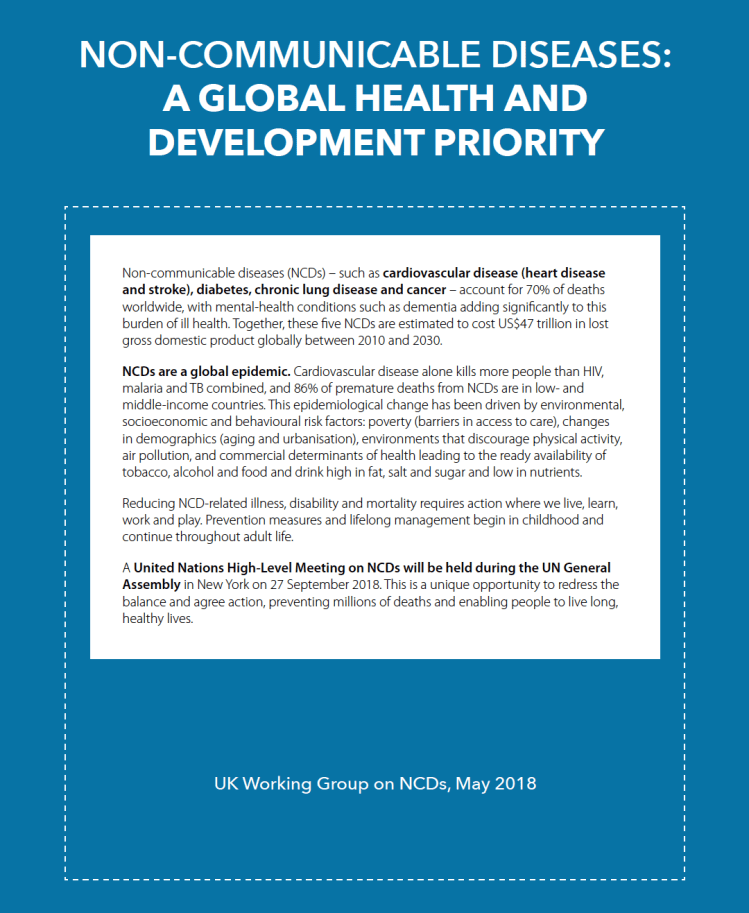
In May 2018, the Working Group held a Parliamentary briefing event in Portcullis House with participation from the All-Party Parliamentary Group on Global Health, the Department of Health and Social Care, Public Health England and the Department for International Development (now the Foreign, Commonwealth and Development Office). It was an excellent opportunity to engage with civil servants across not only in the health/NCDs agenda, but also across development and research – in both of which the UK is a world leader. A briefing paper produced for the event is available below. This event aimed to inform and engage policymakers ahead of the UN High-level Meeting on NCDs, held in September 2018 during the UN General Assembly.
 UK Working Group on NCDs